The best NIOSH-approved N95 masks, according to doctors
These respirators are more protective than KN95s, KF94s and other types of disposable face masks.


DemeTECH N95 Respirator
$48.00
$110.00

Want more from NBC Select? Sign up for our newsletter, The Selection, and shop smarter.
While curating this list of N95 masks, here's what I kept in mind:
Numerous N95s meet NIOSH’s requirements, but the CDC recommends leaving surgical-grade masks for medical professionals. Excluding those options, I compiled highly rated NIOSH-approved N95 masks you can shop online. Note that some N95s come packaged together, while others are individually wrapped. All the masks listed below have an adjustable nose bridge and two headstraps.
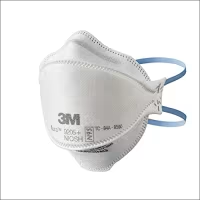
3M’s Aura foldable N95 respirator has a three-panel design and is made to be low profile around the nose and eye area to accommodate glasses. They come individually packaged and are sold in packs of three at minimum — you can purchase larger packs if needed.
You can purchase Shawmut N95 respirators in a pack of 10, 20 or 240. The masks are built with a piece of foam that lines the inside of the adjustable nose piece, which helps reduce eyeglass from fogging up. The N95s come in small and medium/large sizes.
You can fold these N95s from Honeywell totally flat when you're not using them. Their adjustable nose clip has a foam cushion that helps create a tight seal against the face. Masks come in a pack of 20.
The pouch design of these N95s creates a large breathing chamber, making it easier to talk while wearing the respirators, according to the brand. They come in a pack of 50.
DemeTech’s N95s are designed with five layers of material and fold flat when they’re not in use. They come in a pack of 20.
BNX N95 masks fold flat when they’re not in use and have latex-free head straps. They come in a pack of 10.

Regardless of the type of mask you wear, it won’t protect you or the people around you unless you wear it correctly. Make sure your mask completely covers your mouth and nose and fits tightly against your face to prevent gaps around the sides of the mask, nose and chin, according to the CDC.
“N95 respirators will provide the regulated, expected level of protection to the wearer only if there’s a good seal to the face,” says Hines. “You want a good seal so that all of the air that’s breathed in is pulled in through the mask body. That’s where all the filtration of particles and microbial contaminants occurs.”
You can do an at-home leak test with an N95 by putting it on and breathing out, says Rempel. If you can feel the air under your chin or around your eyes, it’s not tight enough. And if your glasses fog up while wearing an N95, there’s leakage and it’s not tight enough, says Hines.
All masks and models fit differently, and features like an adjustable nose bridge help you improve the fit of your mask, as do mask fitters or braces, according to the CDC. Using a fitter or brace is especially a good idea for people with facial hair, which can make it difficult to achieve a tight fit.
There’s no nationwide mask wearing mandate in the United States, so it can be tricky to decide when you should wear one. Here’s what experts recommend — and remember, wearing a mask can help reduce the transmission of illnesses like the flu, RSV and the common cold, not just Covid-19.
In settings where workers are required to wear an N95, like some construction zones and healthcare settings, they have to do an official fit test, says Hines. The public, however, does not need to do a formal fit test before buying and wearing an N95. Regardless, you should still check to see if your respirator fits properly before wearing it in public, she says.
Technically, N95s are disposable, single-use face coverings. But if you remove and store an N95 properly, you can reuse it multiple times — simply put, that entails taking the mask off by its head straps and storing it in a paper or mesh fabric bag between uses, according to the CDC.
N95 manufacturers often provide instructions for the suggested length of use for their masks on the box or online. But in general, you should throw out your N95 if it gets damaged — crumpled up in your bag, for example — or if you can no longer achieve a tight seal to the face. You should also replace your N95 if it gets wet, dirty or contaminated.
N95 respirators are not intended for use by children and have not been broadly tested on them, according to the CDC. However, some brands offer N95s in small and large sizes, and smaller N95s may fit some children’s faces. Select brands make kids KN95s , too. When it comes to kids’ face coverings, it’s crucial to choose a well-fitting and comfortable option to reduce the chance of children removing it often or wearing it incorrectly, according to the CDC.
Yes, N95 masks are eligible for reimbursement with a flexible spending account (FSA), health savings account (HSA) or health reimbursement arrangement (HRA). They are not eligible with a dependent care flexible spending account (DCFSA) or a limited-purpose flexible spending account (LPFSA).
At NBC Select, we work with experts who have specialized knowledge and authority based on relevant training and/or experience. We also ensure that all expert advice and recommendations are made independently and with no undisclosed financial conflicts of interest.
I’m a reporter at NBC Select who has written about face masks since 2020, including articles about KN95s, N95s, disposable face masks and kid’s face masks. To write this article, I interviewed four doctors about how to shop for N95 masks and researched face coverings using resources from the CDC and NIOSH. I also recommended NIOSH-approved N95 masks to buy that meet expert guidance.
Catch up on NBC Select’s in-depth coverage of tech and tools, wellness and more, and follow us on Facebook, Instagram, Twitter and TikTok to stay up to date.


